How I Actually Run SEO for Small Businesses in 2026
And what I no longer do.


Why Most Small-Business SEO Advice Breaks Down
Most mainstream SEO advice still pushes the idea that more content is always better, usually in the form of constant blogging. After five years of working with small businesses, I haven’t seen strong evidence that this approach consistently drives long-term SEO growth. In fact, some of the most consistent results I’ve seen have come from smaller websites with little to no active blog. Blog content can help build authority, but using it as the primary driver of SEO ignores the bigger picture.
Google doesn’t rank individual posts in isolation. It evaluates the entire website, the domain as a whole, to determine whether it’s a credible, authoritative source worth ranking consistently over time. A blog post might spike traffic or even go semi-viral, but that kind of attention rarely builds the foundation needed for sustained SEO performance.
I often explain this to clients by comparing a website to a book. A great chapter doesn’t make you a New York Times bestseller. The entire book matters. The structure, the clarity, the consistency, and yes, the cover. As much as we like to pretend otherwise, books are judged by their covers, and websites are no different. Design, usability, performance, and organization all shape how both users and search engines perceive quality. One strong blog post can’t carry a site that’s disorganized, outdated, or difficult to use.
In practice, this is where most small-business SEO breaks down:
- Too much focus on publishing content instead of improving core pages
- Treating blog posts as standalone wins instead of part of a larger system
- Ignoring usability, design, and structure in favor of volume
- Expecting SEO to keep working after effort stops
The reality for small businesses makes this disconnect even worse. Most owners don’t have the time, expertise, or internal resources to maintain a website at the standard Google now expects. Algorithm updates, technical requirements, performance expectations, and now AI-driven search changes all demand ongoing oversight. None of this is especially complicated on its own, but together it requires consistency and attention that small teams rarely have.
Another pattern I see constantly is what I call the one-and-done fallacy. A business sees early progress, rankings improve or traffic spikes, and they assume the momentum will carry itself forward. The work slows down or stops altogether. In almost every case, performance doesn’t just plateau, it slides backward, often to a worse position than where it started. SEO momentum isn’t a snowball you push once and walk away from. When you stop applying pressure, it loses speed fast.
When a business sees early SEO progress, stops the work, and assumes momentum will continue on its own.
The most damaging assumption underneath all of this is that more activity automatically leads to better SEO. Thin, redundant, or low-value content can dilute authority, consume crawl budget, and weaken the overall site. Strong SEO foundations are built on clarity, usefulness, technical stability, and consistency, not volume. A clean, focused, well-maintained website will almost always outperform a larger site that’s trying to do too much.
The One Principle That Guides All My SEO Work
If I had to reduce my entire SEO philosophy to one idea, it would be this: a website has to be useful. When I say a website needs to be useful, I mean it needs to be:
- Easy to navigate
- Clearly designed
- Honest about what it offers
- Focused on answering real questions
- Built to help users take the next step
It’s about making your website useful, usable, interesting, and informative.
The first thing I optimize when I take on a new client is expectations. Before touching a website, I need clients to understand what SEO is, how it works, and what realistic progress looks like over time. SEO only helps the bottom line when it’s aligned with how the business actually operates, and that requires education upfront.

Once that foundation is set, the first hands-on work I usually start with is metadata. Metadata might sound cliché, but it’s the introduction to every page on a website. The title tag and meta description set the tone for what a page is about, both for search engines and for real people. I use metadata as a diagnostic tool. If I can’t clearly and confidently describe the purpose of a page in a title tag and description, that’s usually a sign the page itself isn’t very useful. This process helps separate the pages worth investing in from the fluff that needs to be trimmed, consolidated, or reworked.
Focusing on the metadata helps me quickly identify:
- Pages with unclear purpose
- Content that’s trying to do too many things
- Pages that should be consolidated or removed
- Pages worth expanding and investing in
One thing I deprioritize immediately is backlinks. They’re buzzworthy and hard to ignore, but there’s very little you can do to directly control high-quality backlinks in a meaningful, sustainable way. Chasing them too early often turns into a shortcut mentality. Using the book analogy again, it’s like paying people to leave glowing reviews for a book that isn’t very good. You might get someone to pick it up, but they won’t read it, recommend it, or come back for more.
Early in my career, I leaned on backlinks more heavily because they were an easy “gotcha.” Over time, experience taught me that sustainable SEO isn’t about exploiting gaps. It’s about building something that deserves to rank.
How I Decide What to Work on Each Month
Every SEO engagement I run starts with an audit. It’s not just my most popular offering, it’s the most useful one. An SEO audit gives me a clear picture of how a website is actually performing, not how it looks on the surface.
An SEO audit helps me understand:
- Ranking keywords and top-performing pages
- Off-page signals that actually matter
- Technical SEO and site performance
- Schema markup and rich result eligibility
- Design, usability, and overall experience
Once I understand the landscape, I move into Google Search Console and focus on the last 90 days of data. I’m not hunting for anomalies or one-off spikes. I’m looking for patterns. The pages that immediately grab my attention are the ones with high impressions and low clicks. These pages tell a very specific story. Google is surfacing them, ranking them, and testing them in search results, but users aren’t engaging.
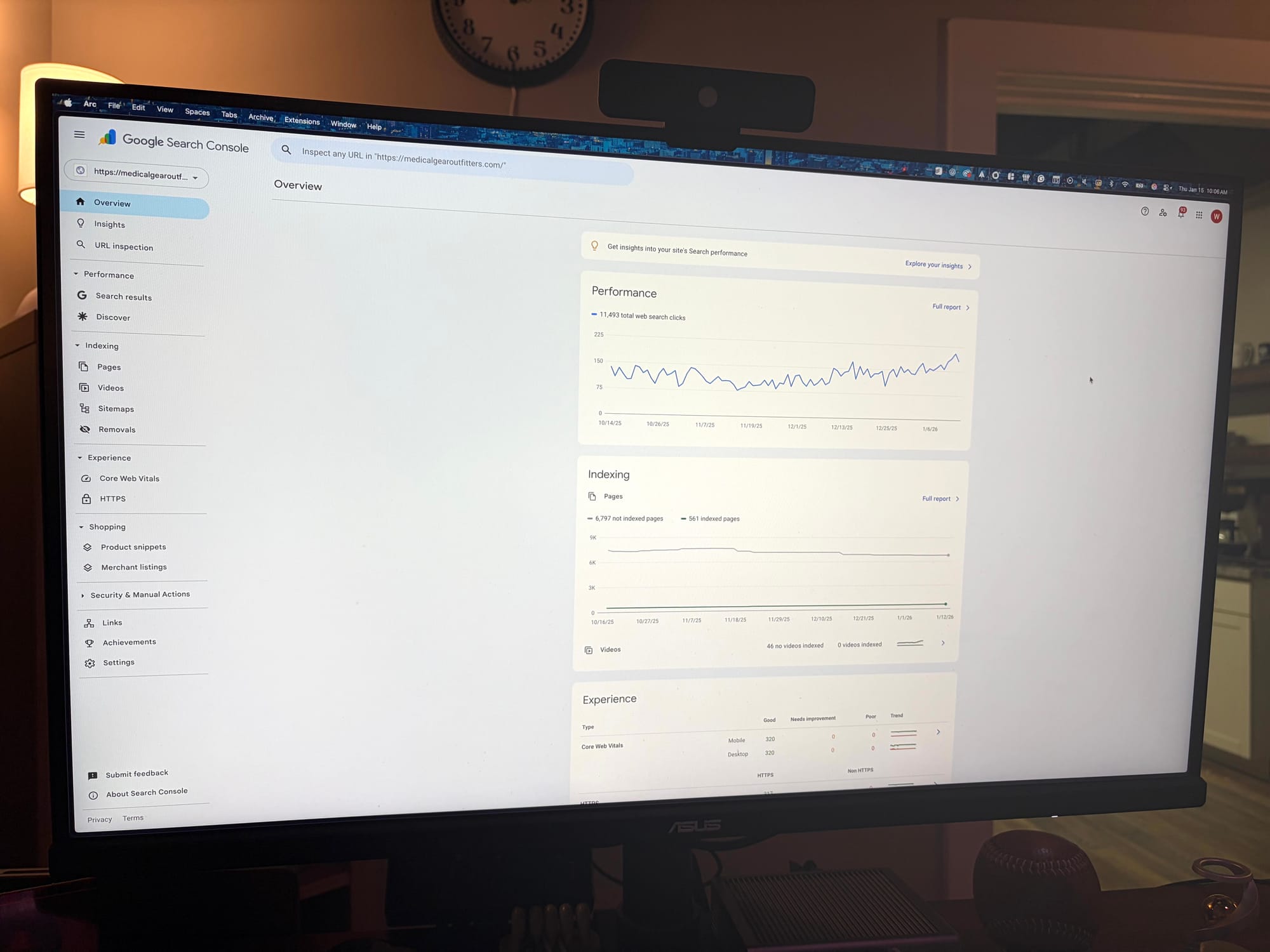
Pages with high impressions but low clicks usually signal:
- Weak titles or meta descriptions
- Intent mismatch
- Poor positioning compared to competitors
- A page that needs clearer framing, not more content
I find these pages fascinating. They’re like riddles. Something about them is holding people back. Using the book analogy again, it’s like a book sitting on a shelf in a busy bookstore. People walk past it every day, but no one picks it up. That usually means the cover, the title, or the positioning isn’t doing its job.
A page is worth working on when two things are true. First, the topic is genuinely useful and deserves more visibility. Second, the page already shows signs of potential, usually through existing rankings or impressions. That gap between visibility and engagement is where meaningful SEO improvements tend to happen.
Why I Don’t Start With Blogs, Keywords, or Tools
I don’t start SEO with blogging because blogs are not the foundation of a website. They’re the branches. The foundation is the homepage and core service pages that explain what you actually do and why it matters. Those pages carry the weight of authority. Blog posts only work when they support those pillars, not when they exist on their own.
But a strong website earns authority.
Blogs are supplemental chapters, not the core narrative. A strong appendix doesn’t save a weak book. Your foundational pages need to be clear, informative, and genuinely useful before blogs can effectively extend your expertise.
I also don’t start with keywords in the traditional sense. Keywords still matter, but treating them as the strategy is outdated. People don’t search with one or two words anymore. They search with questions, problems, and full scenarios. SEO today is less about chasing isolated terms and more about understanding intent and context.
Finally, I don’t let tools drive the strategy. Tools are helpful for research and validation, but they can’t replace judgment. An algorithm can surface data, but it can’t fully understand your business, your customers, or why someone chooses to buy. Successful SEO requires empathy and the ability to think like a user. No tool can replicate that.
Sequence matters. Get the foundation right first, and everything else works better.
They are not the strategy.
What SEO Work Actually Looks Like in Practice
At its core, good SEO is about making your website useful, usable, interesting, and informative. If one or more of those things is missing, it becomes incredibly difficult to gain traction in Google.

Google’s goal is simple. It wants to serve the most satisfying results so users keep coming back. What it pays attention to is behavior. Do people click your result? Do they stay on the page? Do they engage, or do they bounce back to search results?
Those behaviors are the real signals. If a page is confusing, slow, cluttered, or distracting, users feel it immediately, and Google eventually sees it reflected in the data. That’s why I always look at a website’s homepage and core pages first. You can have the right keywords and technically correct SEO, but if the page doesn’t answer the intent behind the search, it won’t perform.
This is also why so many businesses feel like SEO “never worked” for them. The site may have been optimized, content added, or links built, but the foundation was never healthy. Pages are hard to use. Things don’t function correctly. Pop-ups interrupt the experience. When that happens, attention drops and Google has no reason to reward the site.
SEO only compounds when the foundation is solid. Fix the fundamentals first, and everything else has something to build on.
A: Yes, but only when it’s focused on usefulness, intent, and user experience. AI hasn’t replaced SEO, it’s raised the bar for what deserves visibility.
What Clients Are Really Paying Me For
At the start, clients hire me to elevate their visibility on Google. Search results are a storefront window. The businesses that appear front and center get the attention, clicks, and opportunities. Most clients know they should be visible there, but they don’t know why they aren’t or what it would take to change that. They pay me to diagnose the situation and position them so they have a real chance to compete.
Once that visibility improves, the work shifts to protecting and compounding that progress. SEO changes quietly. Algorithms shift. Competitors adjust. User behavior evolves. Someone has to be watching those changes closely. That’s part of the value I provide.
Experience matters here. It’s not just about paying attention, it’s about knowing which signals matter and what actions are worth taking. Over time, I’ve learned how to recognize patterns, adjust strategy in real time, and keep sites moving in the right direction.
Clients also pay me to think ahead. That means staying current with Google changes, industry trends, and competitor movement so they don’t fall behind without realizing it.
Ultimately, clients are paying for experience and judgment. More visibility means more opportunities to earn trust, generate leads, and grow revenue. Everything else is just how we get there.
A Final Note
If SEO isn’t something you care about, we probably won’t be a good fit. This work takes patience, attention, and a willingness to invest in doing things the right way. It’s not a quick fix.
But if you do care about SEO, understand that it’s a process, and want your website to become a real growth channel through Google, I’m happy to help. I enjoy working with people who value foundations, long-term progress, and thoughtful execution.
If that sounds like you, feel free to reach out when you’re ready.
